Number and Place Value
Reading numbers in the millions, rounding and negative numbers are all key concepts for Year 5.
By Year 5 children are expected to be working with larger numbers, including hundreds of thousands and millions. However, many children, and indeed adults, find it very difficult to read large numbers correctly. The solution is to section the digits off into groups of three, starting with the units.
The first group of three is read as hundreds, tens and ones.
e.g.789 is seven hundred and eighty nine
The second group of three is read as hundreds, tens and ones of thousands.
e.g. 456 789 is four hundred and fifty six thousand, seven hundred and eighty nine
The third group of three is read as hundreds, tens and ones of millions.
So: 123 456 789 is one hundred and twenty three million, four hundred and fifty six thousand, seven hundred and eighty nine
Whilst we read the number from left to right, working out the value of the number is easier by working in threes from right to left!
There is an emphasis on using large numbers in Years 5 and 6. For example, the new targets for Year 5 Number includes:
round any number up to 1 000 000 to the nearest 10, 100, 1000, 10 000 and 100 000
Now this might sound fairly straightforward but for many children it will pose considerable difficulty. By Year 5, children should already be able to round to the nearest 10, 100 and probably 1 000, but dealing with very large numbers can cause confusion.
When rounding to the nearest 10 000 the key figure is the thousands digit. If the thousands digit is 5 or above, round up. If it is below 5, round down.
e.g. 327 550 is 330 000 to the nearest 10 000.
324 259 is 320 000 to the nearest 10 000
(Note that when rounding to the nearest 10 000 it does not matter what the hundreds, tens or oness digits are, it is the THOUSANDS digit which must be looked at.)
When rounding to the nearest 100 000 the key figure is the ten thousands digit. If the ten thousands digit is 5 or above, round up. If it is below 5, round down.
e.g. 277 550 is 300 000 to the nearest 100 000.
237 259 is 200 000 to the nearest 100 000
Counting
Counting forwards and backwards for any given number up to one million.

Counting on from large numbers in powers of ten.


Read, write and compare numbers
Read, write and compare numbers up to one million.


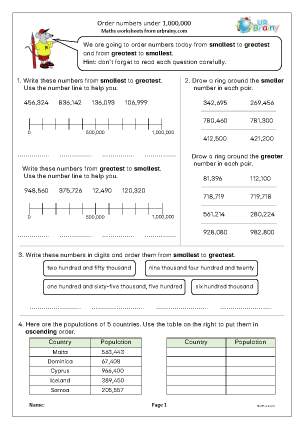

Compare and order 6-digit numbers.

Place value
Determine the value of each digit in numbers up to one million.


Rounding numbers
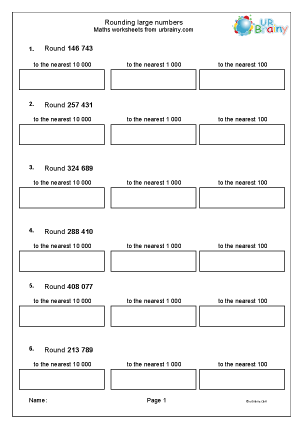
Round any number up to millions, to the nearest 10, 100, 1000, 10 000 and 100 000. Estimating and approximating.




Negative numbers
Interpret negative numbers in context, counting forwards and backwards, including through zero.


Roman numerals
Read Roman numerals up to 1 000 (M) and recognise years written in Roman numerals.


Other number work
Solve number problems.