Developing quick mental methods of addition is the key to success in Year 3. By the end of the year children are expected to know addition facts to 20 and number pairs that make 100. Techniques for adding one-digit and two-digit numbers are practised as well as adding multiples of 100. Written methods of addition are used for the first time, beginning with ‘jottings’ and moving towards a standard written method.
A tricky set of mental addition questions, adding teens to 2-digit numbers.
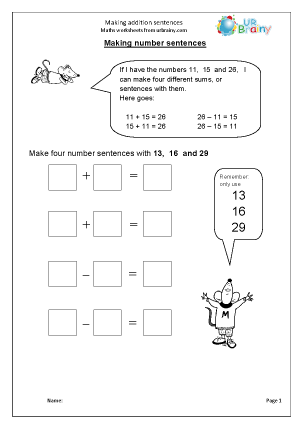
A variety of addition questions, including finding different ways to make totals.
Find three numbers to make totals, with the help of number lines. Two steps to work these out, making them quite hard.
A selection of mini investigations, finding how many different totals can be made.
Practise finding pairs of multiples of 5 that total 100. There are only about ten pairs and if possible they should be learnt.
Knowing pairs of numbers that make 10 will make these pages easy: pairs of multiples of 100 that total 1000.
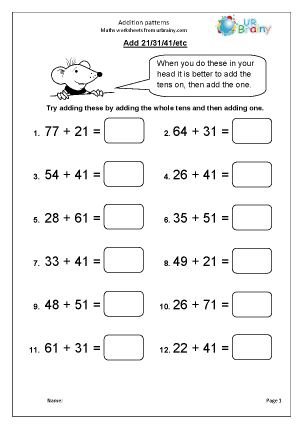
Help with adding whole tens and whole hundreds ‘in your head’.
What number do you need to add to make a total of 100? Probably the best way is to add on to the next whole ten and then count on in tens to 100.
You may have seen tables’ grids: these are addition grids and work in just the same way, adding rather than multiplying.
Adding three numbers: stop watches at the ready to see how quickly these can be completed correctly.
Adding 9 or 11 to 3-digit numbers by adding 10 and adjusting.
Use the technique for adding 9 for adding 19, 29, 39 etc. This makes hard looking calculations quite easy.
More practice at adding the nearest whole ten and adjusting, as well as looking at addition patterns.
Adding several numbers. A useful tip is to look for pairs of numbers that make 10 and do that part of the sum first.
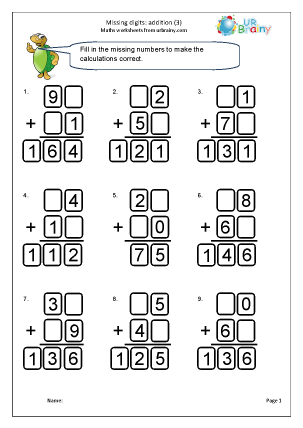
Look at the addition number sentence. What could the two missing numbers be?
Two helpful tips on these pages: skills that are essential for fast mental calculating.
Why not do all your subtractions by adding on? Often it is by far the best method!
Maths is all about patterns. Here we have an addition table with interesting diagonal patterns as well as seeing patterns in addition number sentences.
Several ways to investigate the relationship between addition and subtraction.
Some straightforward adding to hundreds. These give confidence with using larger numbers.
Quick revision of adding multiples of 10. A nice easy break from the hard stuff!
More adding multiples of 10 to 2-digit and 3-digit numbers. The units remain the same in these questions.
Adding multiples of 100, often crossing the thousands boundary.
For those children who need a little extra practice at addition using mental techniques learnt earlier.
Techniques to help with understanding written methods subtraction. Jottings only at this stage, which some find rather complicated.
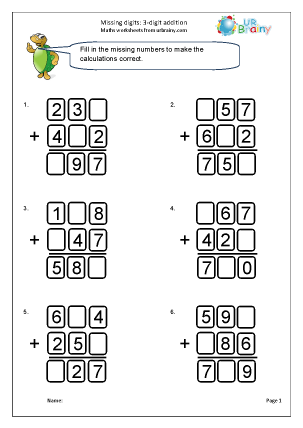
Moving towards the standard method of written addition, adding the least significant figures first (units).