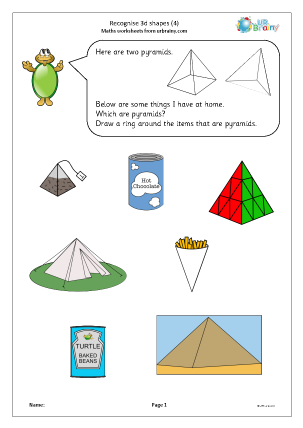
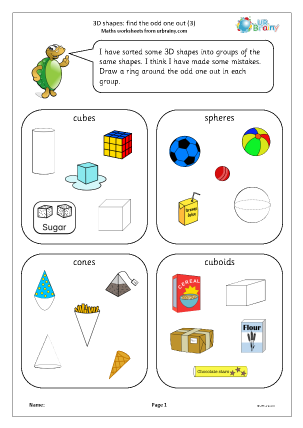
A really fun category with lots to do during the year on shape and measures, including making patterns and pictures with 2D shapes. Children should be able to recognise and name common 2D shapes, such as circle, triangle, rectangle and square as well as 3D shapes such as cube, cuboid, sphere, cone and cylinder. Most of this should be done orally with practical equipment.
Measuring is seen in terms of comparisons, using non-standard units (eg hand spans) saying which is longer, taller, heavier, lighter etc. There is also plenty of opportunity to get wet when measuring jugs of water! Encourage children to make sensible estimates related to length, mass and capacity.
A look at shape patterns using circles, squares, triangles and rectangles.
Continue the pattern of colours shown on the shapes.
Draw and colour the next two shapes in the series.
Can you draw and colour the missing shapes in these patterns?
More patterns, but there may be more than one possible pattern on some.
Continue the patterns of shapes.
Here we have some great pages which will help your child to recognise the four basic 2-D shapes: circles, squares, rectangles and triangles. You can also have great fun with making pictures of your own just using these shapes. Find plastic shapes or even sticky materials from craft stores which can be used in scrapbooks.
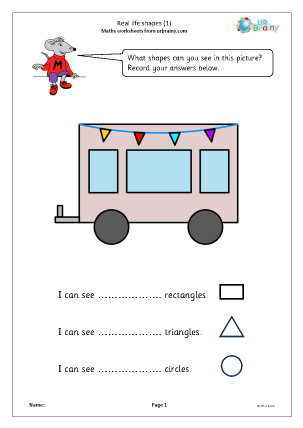
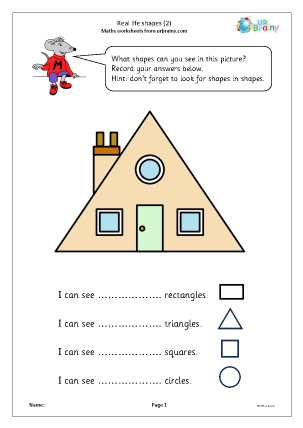
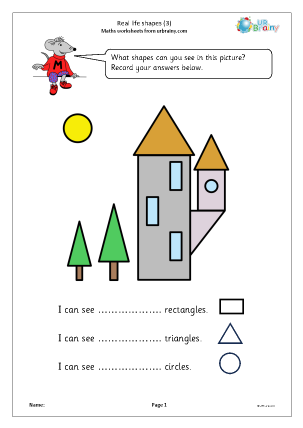
A great set of four worksheets helping with recognising rectangles, triangles and circles.
Children soon become familiar with squares, triangles and circles. As well as looking at these 2D shapes, this set of worksheets also introduces other 4 sided shapes and ovals.
More work with squares, triangles and circles and a great train drawing page.
More great pages on recognising 2D shapes and drawing quadrilaterals, circles and triangles to complete a picture.
Make two triangles by drawing one straight line. A ruler would be useful.
Introducing lines of symmetry and colouring spots to show reflective symmetry.
A set of balance scales and objects to measure needed for this activity.
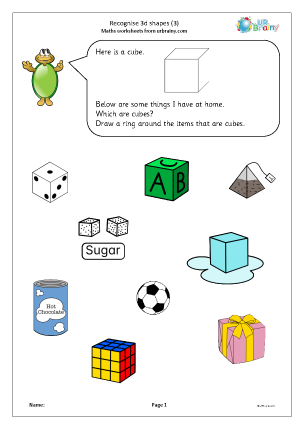
Recognising cubes, cuboids, cylinders and cones.
3D shape recognition and work with cubes.
Do you know your left turns from your right?
Choose your favourite colour to halve each of the shapes.
Measuring length using non standard units such as paper clips.
Measuring using handspans - but mind your fingers!
Matchsticks are a great resource for early measuring activities.
An introduction to the idea of a ruler for measuring.
Measure using a short ruler length.
Early stages of using the language of capacity: half full etc.
Plenty of bottles, cups and containers needed for this watery activity. Tip: if you want to stay dry use sand!
A saucepan and a selection of cups and mugs for this estimating and measuring activity.
Comparing amounts to a litre and remember: a litre of water weighs a kilo.
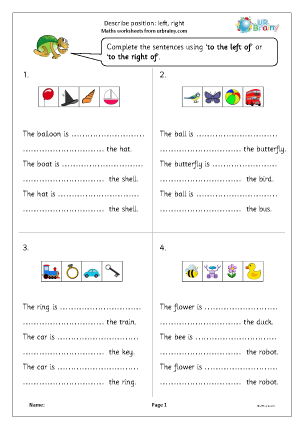
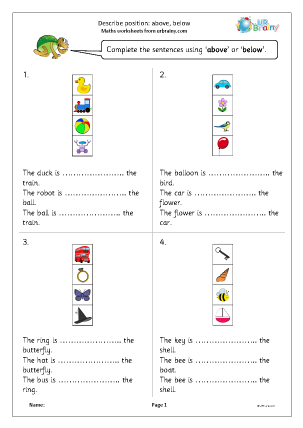
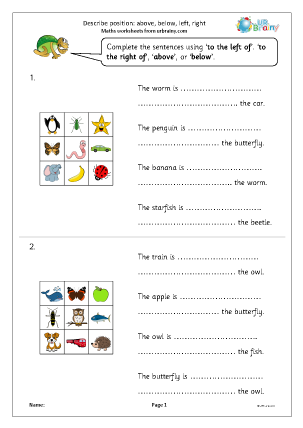
Understanding and learning the vocabulary of position.
Colour the dolphins according to the instructions.